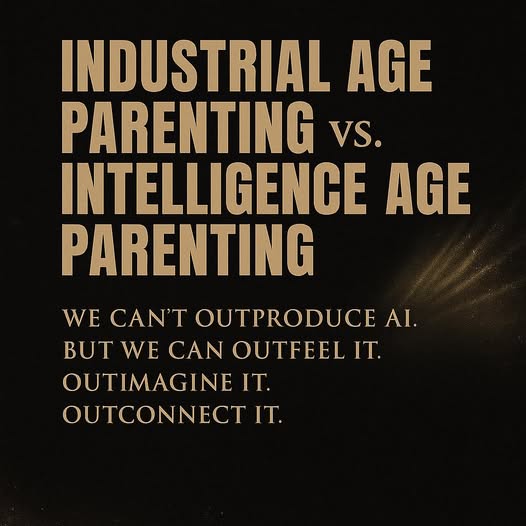
Industrial Age Parenting vs. Intelligence Age Parenting
For most of history, parenting wasn’t about awareness.
It was about survival.
Then came the Industrial Age — the era that shaped everything from how we work to how we parent.
Children were raised to fit systems, not challenge them.
To follow rules, not question them.
To produce, not imagine.
Parents were told that discipline builds character.
That obedience equals respect.
That success looks like grades, trophies, and job titles.
And for a while, it worked.
That model created workers who could thrive in factories, offices, and predictable career paths.
But the world those systems were built for no longer exists.
We’re now in the Intelligence Age — a world where AI can think faster, calculate better, and outperform most of what we used to call “hard work.”
So if machines can do all that, what do we want our children to become?
Because we can’t outproduce AI.
But we can outfeel it.
Outimagine it.
Outconnect it.
That means the parenting paradigm has to evolve too.
Industrial Age Parenting
Prioritised achievement over alignment
Focused on control over connection
Taught children to follow systems instead of build them
Valued perfection over authenticity
Raised children to fit in, not to stand out
Intelligence Age Parenting
Prioritises emotional intelligence as much as IQ
Focuses on regulation before reaction
Teaches children to design their own systems
Values authentic expression over external validation
Raises children who think critically, feel deeply, and lead consciously
Small Shifts to Prepare Your Child for the Intelligence Age
1️⃣ Replace correction with curiosity
Instead of “Why did you do that?”, try “What were you feeling when that happened?” — it moves the conversation from fear to understanding.
2️⃣ Schedule calm, not just activity
Protect at least one “no-agenda hour” each week where you and your child can rest, reflect, or just be — that’s where creativity grows.
3️⃣ Teach them to teach you
Ask your child to show you how they use a new app, AI tool, or idea. It signals that learning never stops — for either of you.
4️⃣ Value effort over outcome
Celebrate curiosity, resilience, and kindness as much as grades or awards. These are the skills that will still matter when everything else automates.
5️⃣ Model emotional regulation
Let them see you pause before reacting, apologise when you overstep, and start again. That’s leadership in its most human form.
Our job as parents now isn’t to prepare our kids for a world that once was —
It’s to help them navigate a world that’s still being written.
That requires presence, not perfection.
Curiosity, not control.
And the courage to admit — “We’re learning too.”
Because the truth is:
Our children aren’t here to repeat what we did.
They’re here to remind us what’s possible.
Which shift will you try out?